
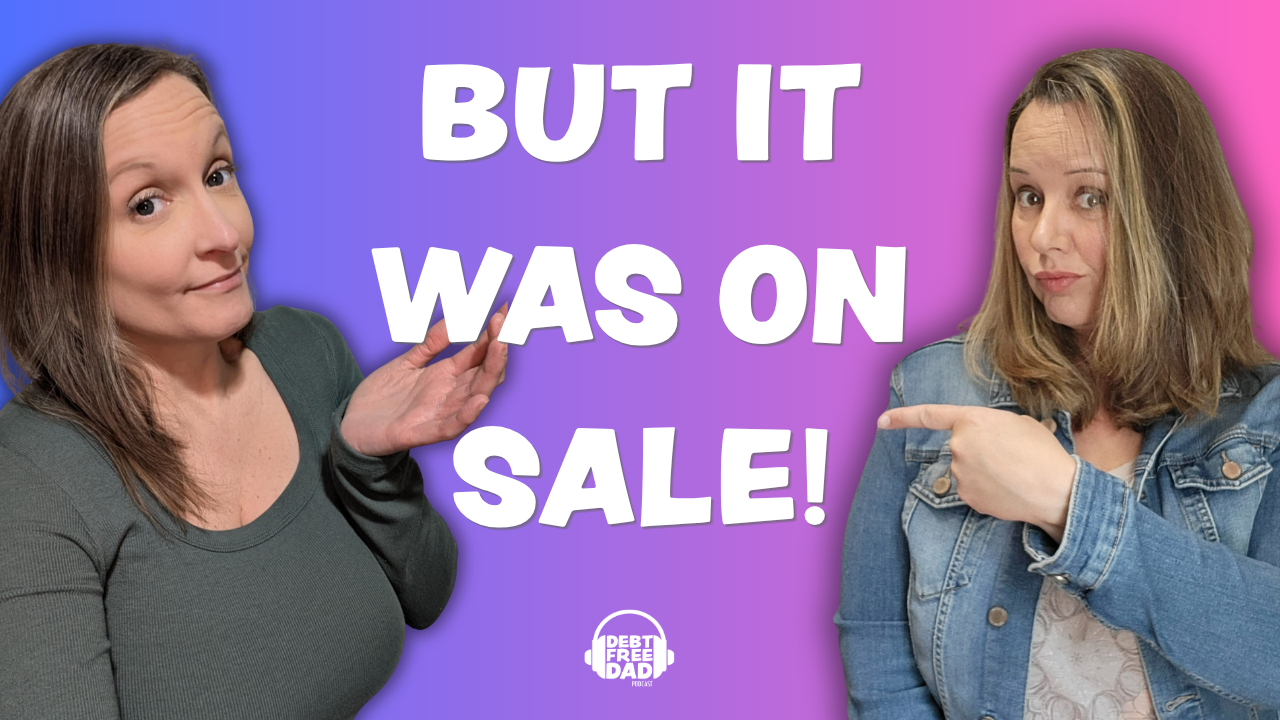
Episode: 399 - Girl Math: The Funny Money Lies That Keep Us Broke
Get our free Simplify My Money newsletter and start taking control of your finances: https://www.debtfreedad.com/newsletters/simplify-my-money
If it's under $10, it's basically free.
If you return something and get $50 back, congratulations! You just made $50.
And if something was originally $100 but you bought it on sale for $60, you didn't spend $60. You saved $40!
Sound familiar?
Welcome to the world of Girl Math, where we can somehow convince ourselves that spending money is actually saving money.
It's funny, it's relatable, and most of us have probably done it at some point. But here's where things get interesting.
What happens when those funny little money stories start costing us real money?
On a recent episode of the Debt Free Dad Podcast, Amber and Katie took over the show to talk about the hilarious ways we justify purchases, the psychology behind those decisions, and how changing the way we think about spending can help us build a better financial future.
The Problem Isn't Girl Math. It's the Stories We Tell Ourselves.
We've all been there.
You see something on sale and suddenly convince yourself you need it. You add another item to your online shopping cart just to qualify for free shipping. Or you grab a few extra things at Target because, technically, you were there for groceries anyway.
Individually, these decisions might seem harmless.
What's another $5 here or $10 there?
But when these little purchases happen several times a week, they can quietly drain hundreds or even thousands of dollars from your budget.
The real issue isn't necessarily what you're buying. It's how you're justifying the purchase.
When we constantly change the story around our spending to make ourselves feel better, we stop paying attention to what our money is actually doing.
And that's where financial trouble can begin.
A Sale Isn't Always a Savings
Let's talk about one of the biggest spending traps: sales.
Imagine finding a pair of boots originally priced at $100, now marked down to $60.
Your brain immediately celebrates. You saved $40!
But did you?
If you were already planning to buy those boots, had the money set aside, and found them at a lower price, absolutely. That's a smart purchase.
But if you weren't planning to buy boots at all, you didn't save $40.
You spent $60 you weren't planning to spend.
Retailers understand this psychology. Limited-time offers, discount codes, loyalty rewards, and targeted advertising are all designed to make us feel like we're missing out on something valuable.
And sometimes, getting a good deal becomes more exciting than actually needing the item.
Before your next sale purchase, ask yourself one simple question:
Would I still want this if it weren't on sale?
Your answer might save you more money than the discount ever would.
Free Money Isn't Always Free
Gift cards, cashback rewards, store credits, and refunds can all feel like bonus money.
But that doesn't mean they should automatically become spending money.
Getting $50 back from a return doesn't mean you've earned an extra $50. It means you've recovered money you previously spent.
The same goes for credit card rewards.
Earning points or cashback might sound fantastic, but if you're carrying a balance and paying interest, those rewards can quickly lose their value.
Katie shared how she once earned credit card rewards while paying significantly more in interest than she received back.
That's not winning the rewards game.
That's paying for the privilege of collecting points.
Rewards only benefit your finances when you're not spending extra to earn them or paying interest that wipes out their value.
The Sneaky Cost of Small Monthly Payments
Another popular justification sounds something like this:
"It's only $25 a month."
Or maybe it's four easy payments of $25.
The problem is that we often focus on the payment instead of the total purchase price.
Buy now, pay later services make it incredibly easy to purchase something immediately without feeling the full financial impact.
But those payments still have to come out of future paychecks.
And when you have multiple payment plans running at the same time, those small amounts can quickly become a serious strain on your budget.
Before committing to another monthly payment, ask yourself:
Can I afford the entire purchase, not just the payment?
And more importantly, do I actually need it right now?
Sometimes the smartest financial decision is simply waiting until you have the money.
Free Shipping Can Be Surprisingly Expensive
Here's another classic spending trap.
You're shopping online and discover you're only $10 away from qualifying for free shipping.
Shipping costs $8.
So naturally, you add a $20 item to your cart to avoid paying that $8.
Congratulations! You just spent an extra $12.
And if that additional item wasn't something you needed, you've actually spent more money trying to save money.
It's a perfect example of how easily we can convince ourselves that spending more is somehow the smarter choice.
Sometimes paying for shipping is cheaper.
And sometimes closing the browser altogether is the best deal you'll find.
Let's Try Some GOOD Girl Math Instead
What if we started using that same creative energy to justify saving money instead of spending it?
Here are a few examples Amber and Katie discussed on the podcast.
Cancel a $40 monthly subscription.
That's $480 a year you can put toward savings or debt instead.
Skip one $30 impulse purchase every week.
That's $1,560 a year that stays in your pocket.
Pay off a $300 monthly car payment.
That's $3,600 a year in freed-up cash flow, assuming you don't immediately replace it with another car payment.
Those three changes alone represent $5,640 a year that could be redirected toward your financial goals.
Now that's some math worth celebrating!
Imagine what you could accomplish with that money.
You could build an emergency fund, pay off credit card balances, save for a vacation, or simply give yourself some much-needed breathing room between paychecks.
And unlike the imaginary savings from an impulse purchase, these are real dollars you get to keep.
How to Stop Talking Yourself Into Purchases
Breaking the habit of justifying spending doesn't mean you have to stop having fun or buying things you enjoy.
It means becoming more intentional.
Start by asking yourself a few simple questions before making a purchase:
-
Would I buy this if it weren't on sale?
-
Do I actually need this, or do I just want it right now?
-
Can I afford the entire purchase?
-
Am I buying this because I'm stressed, bored, or having a bad day?
-
Could I wait 24 hours before deciding?
That last question can be especially powerful.
Giving yourself even a little time between wanting something and buying it can help you determine whether the purchase really matters to you.
And remember, buying better quality can sometimes be the smarter financial choice, too.
A good pair of shoes that lasts for years may be a better investment than constantly replacing cheaper ones.
The goal isn't always to spend the least amount of money.
The goal is to spend your money in ways that actually support your life and your financial goals.
Financial Freedom Starts With Being Honest About Your Spending
At Debt Free Dad, we believe you should be able to enjoy your money without constantly worrying about how you're going to pay your bills.
But getting there requires being honest about where your money is going.
It's okay to buy something because you want it.
It's okay to enjoy a sale.
And it's absolutely okay to treat yourself once in a while.
Just don't convince yourself that spending money you hadn't planned to spend is somehow making you richer.
Because the biggest problem with Girl Math isn't the funny calculations.
It's when those calculations become excuses that keep you stuck in the same financial habits.
The next time you catch yourself saying, "But it was on sale!" or "It's basically free!" take a second to look at the real numbers.
Your future self, and your bank account, will thank you.
Listen to the Full Episode
Want to hear Amber and Katie share their own hilarious Girl Math moments, shopping confessions, and practical tips for making smarter money decisions?
Catch the full conversation on the Debt Free Dad Podcast: Girl Math: The Funny Money Lies That Keep Us Broke.
Visit Debt Free Dad to find the podcast and more free resources to help you take control of your finances.
And if you're ready to stop living paycheck to paycheck, start saving money, and finally make progress toward becoming debt-free, sign up for our free Simplify My Money newsletter.
Because getting better with money doesn't have to be complicated. Sometimes it just starts with being honest about the math.


