
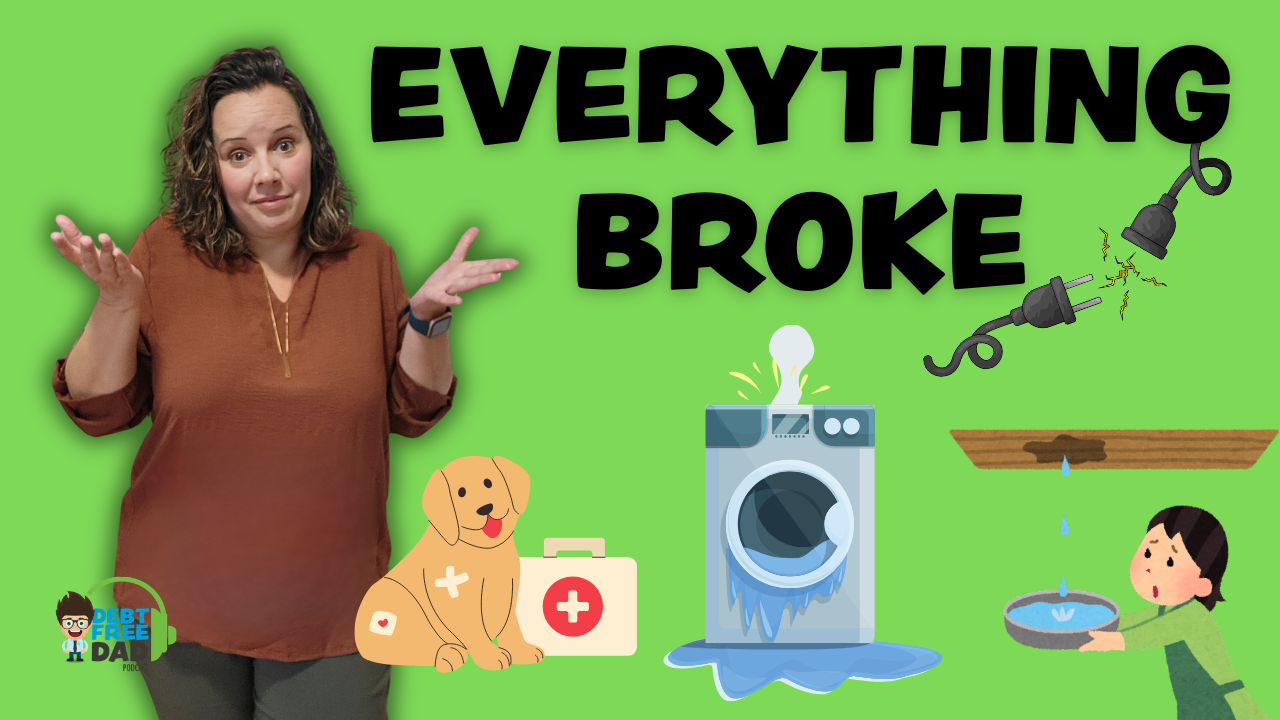
Episode: 393 - When Everything Breaks at Once: Why Your Emergency Fund Matters
Get our free Simplify My Money newsletter and start taking control of your finances: https://www.debtfreedad.com/newsletters/simplify-my-money
Have you ever had one of those stretches where it feels like life is trying to test you?
Not one thing.
Not two things.
Everything.
Over the past few months, my husband and I dealt with a crushed air conditioner, trailer repairs, a roof leak, a washing machine replacement, and an unexpected vet bill after our dog Augie got into a fight with another dog.
None of those expenses were fun.
None of them were planned.
But none of them became debt.
That's exactly why emergency funds matter.
What Actually Counts as an Emergency?
One of the biggest questions people ask is:
"What should I use my emergency fund for?"
Just because something is unexpected doesn't automatically make it an emergency.
Just because something is expensive doesn't automatically make it an emergency either.
For me, an emergency is usually something that:
- I didn't see coming
- Needs to be dealt with quickly
- Can't reasonably be postponed
A giant chunk of ice crashing onto your air conditioner?
Emergency.
A roof leak causing damage inside your home?
Emergency.
A dog needing immediate veterinary care after a fight?
Emergency.
These are situations that require action, whether you're financially ready or not.
What Isn't an Emergency?
This is where people often get into trouble.
Many expenses feel like emergencies because they're inconvenient.
But inconvenient and emergency are not the same thing.
Things like:
- Tires
- Brakes
- Oil changes
- Routine home maintenance
- Annual vet visits
- Vaccinations
- Flea and tick prevention
These are predictable expenses.
You may not know exactly when they'll happen, but you know they're coming.
That's why they shouldn't come from your emergency fund.
They should come from savings categories specifically set aside for those expenses.
The Power of Planning Ahead
One thing I've noticed as we've gotten better with money is that fewer things feel like emergencies.
Years ago, every unexpected expense felt like a crisis.
A car repair would create stress.
A vet bill would create panic.
A home repair would immediately lead to worrying about credit cards and debt.
Today, many of those expenses already have their own savings categories.
We save for:
- Vehicle maintenance
- Pet expenses
- Home repairs
- Future appliance replacements
That doesn't eliminate surprises.
But it dramatically reduces them.
The goal isn't to predict every expense life will throw at you.
The goal is to reduce the number of financial surprises.
Using Your Emergency Fund Isn't Failure
A lot of people feel discouraged after they finally build an emergency fund and then have to use it.
It can feel like all that hard work disappeared overnight.
But that's the wrong way to look at it.
Your emergency fund didn't fail.
It succeeded.
Its entire purpose is to be used when an emergency happens.
Without our emergency fund, those expenses from this spring could have easily ended up on a credit card.
Instead, we paid cash.
That's not failure.
That's exactly what financial preparedness looks like.
How to Rebuild Your Emergency Fund
If you've recently used your emergency fund, focus on rebuilding it one step at a time.
You don't have to replace it all immediately.
Start with smaller milestones:
- Build back your first $1,000
- Work toward one month of expenses
- Grow to three months of expenses
- Eventually reach six months if that's your goal
If you're paying off debt, you might temporarily pause extra debt payments and focus on rebuilding your emergency fund.
If you're already debt-free, you may choose to temporarily reduce other savings goals until your emergency fund is back where you want it.
Progress doesn't have to happen overnight.
Small wins create momentum.
The Real Benefit of an Emergency Fund
The biggest benefit of an emergency fund isn't the money.
It's the peace of mind.
When our air conditioner was damaged, when the roof leaked, when the washer died, and when Augie needed veterinary care, we still experienced stress.
But we weren't lying awake at night wondering how we were going to pay for it.
We weren't putting expenses on credit cards.
We weren't choosing between repairs and groceries.
We had a plan.
And that's what an emergency fund really provides.
Not a guarantee that life won't happen.
Just the confidence that when it does, you're ready.
Resources:
The Totally Awesome Debt Freedom Planner https://www.debtfreedad.com/planner
Connect With Brad
Website- https://www.debtfreedad.com
Facebook - https://www.facebook.com/thedebtfreedad
Private Facebook Group - https://www.facebook.com/groups/debtfreedad
Instagram - https://www.instagram.com/debtfreedad/
TikTok - https://www.tiktok.com/@debt_free_dad
YouTube - https://www.youtube.com/@bradnelson-debtfreedad2751/featured
Thanks For Listening
Like what you hear? Please, subscribe on the platform you listen to most: Apple Podcasts, iHeartRadio, Spotify, Tune-In, Stitcher, YouTube Music, YouTube
We LOVE feedback, and also helps us grow our podcast! Please leave us an honest review in Apple Podcasts, we read every single one.
Is there someone that you think would benefit from the Debt Free Dad podcast? Please, share this episode with them on your favorite social network!
Transcript
When Everything Breaks At Once
Amber
Have you ever had one of those time frames where everything decided to break at the same time? Like just a span of a few months where everything just went in your life. The air conditioner, the camper trailer, the roof, the washing machine. Even surprise vet bill. After our dog Augie got into a fight with another dog. And while I definitely wasn't excited about any of these expenses, it reminded me why emergency funds matter so much. Because life really doesn't wait until it's convenient. And sometimes the difference between a stressful situation and a financial disaster is simply having money set aside before you even need it.
What Counts As An Emergency
Amber
Hi, I'm Amber, today's host for the Debt Free Dad podcast, where we help normal, everyday people like you take control of your finances so that you can live a happier, less stressful life. Now, my husband and I paid off $54,000 in debt in just 20 months and have been living debt-free outside of our mortgage since 2018. After listening to today's episode, if you're ready to stop living paycheck to paycheck, reduce financial stress, build your savings, and finally pay off your debt for good, we've got an incredible free resource that I'll be sharing later on in the show. Now, let's start with the question that inspired this entire episode. What actually counts as an emergency? Because I think a lot of people struggle with this. And just because something is unexpected doesn't actually automatically make it an emergency. And just because something is expensive doesn't automatically mean that it's coming out of the emergency fund. For me, an emergency usually means something I didn't see coming, needs to be dealt with, and can't really be put off. So let's look at a few examples from my own experience just in the last few months.
Real Emergencies From Our Home
Amber
So this winter, about 200 pounds of ice came crashing down onto our air conditioner. And we had to wait until spring to deal with it because of all the snow. But I can honestly say I was not planning that one. Um, thankfully, insurance covered most of it, but we still had that $500 deductible, and that's an emergency. Nobody plans for a giant chunk of ice to destroy their air conditioner. Then there was the camper trailer. When we opened it for the season, we discovered electrical and plumbing issues that needed repair. Now, maintenance is part of owning a trailer. Things wear out, but we weren't expecting a $650 repair bill before we could even enjoy our first weekend. That's another situation where using the emergency fund made sense. Then we had our roof leak. Thankfully, the roofing company stood behind their work because we just had it installed five years ago or just under five years ago. Um, so they covered that under a workmanship warranty. Now they fixed the roof itself, but we still have to repair some drywall inside that got damaged from the leak. Now, again, not something we planned for, not something we could ignore. And it came out of the emergency fund. Now, I'm telling you, when life happens, and I know you know this, when life happens, man, does it happen? So, not only that, we also had our washing machine that kind of went kaput. Now, I did try and repair it um about six months prior, and it worked for a little while, and we had started to save for it, but we didn't quite have enough to pay for the whole thing, so we had to dip into that emergency fund. But here's the thing appliances and stuff wear out. Now, did I think my washer should have lasted more than eight years? Yeah. But we dipped into our emergency fund a little bit for that, and we used what we had already saved because we knew it was coming by then when I had to repair it. So we did find ourselves finding a not crazy expensive one and we replaced it with that. But for the first few weeks, we were going to um the laundromat because I wasn't willing to just jump in and just go buy the first washer that I seen. I wanted to shop around, I wanted to find a good deal, and it wasn't like a dire need to have a washing machine. I had other options, right? So, I mean, again, it's reasonable for the emergency fund, but you gotta be prepared for knowing that things will break down, right? Appliances do break, cars do break down,
What Is Not An Emergency
Amber
tires wear out, right? Tires not necessarily an emergency. Like we know these things are gonna wear out. So it's a gray line, like it's a fine line. You're kind of riding the line there with that one. And then there was Augie, our dog. So um, if you've been listening to me before, you know my dogs are family. And this spring, Augie got into a fight with another dog and needed veterinary care. So when something happens to your pet, you don't want to be sitting around debating like whether it's a good month financially to be able to get them the proper care that they need. So I could not predict that Augie would get into a fight. I knew, you know, he's gonna need a veterinary care. Like we bring him in for his normal shots, we plan for that, we bring him in for his check-ins, we plan for that. But at this point, we couldn't know. We could not predict that specific incident, right? So that was an emergency. That needed the emergency fund. Now let's flip to what's not an emergency. Um, because this is where I think a lot of people actually use their emergency fund for things that they probably should have planned a little better for. So, like I mentioned earlier, tires, right? Your vehicle is going to need tires every so often. You don't know exactly quite when. It all depends on how much you're driving and all of that. There's a lot of things, but you know tires are going to be a thing. So that's more of a maintenance thing, right? And the same thing goes for your brakes on a car or an oil change. Those are maintenance things. So you want to have a fund for maintenance, but you want to have a fund for emergency funds, right? You need something for emergencies, you need something for maintenance. It's really good practice to have those all set aside and planned for. Now, the vehicle things are expected costs, right? When it comes to vehicle ownership. The same goes for appliances. And I know we kind of I dipped into my emergency fund because I wasn't quite saved up enough for the new washer that I kind of knew was coming based on the fact that I had to like replace a part and use YouTube and all the things. If your fridge is 15 years old and it sounds like it's preparing to like take off every time that it turns on, you might want to start saving for replacement. And I feel like that comes into account with your home. Like if you own a home or if you own appliances, whatever that looks like, you want to be saving for maintenance on your home, saving for maintenance on your car. So I think it's really important to have maintenance funds and then also emergency funds and to know the difference between the two. Now, a routine pet expense isn't an emergency. Vaccinations, annual exams, flea and tick prevention, routine medications, those are not emergencies. Those are predictable, those can be added into your budget and they should be worked in every single month. And I know for us, like we're not paying those every single month, and you probably aren't either, but you want to at least work it out. Like the best way to do that, I find, is um get the full picture, the full price of what you expect for the year, divide it by 12, and just put it away every single month.
Maintenance Funds Vs Emergency Funds
Amber
Now, one of the things I've noticed as we've gotten better with money is that fewer things feel like emergencies. Years ago, almost everything felt like a crisis. Car repairs, vet bills, home repairs, every unexpected expense felt stressful because we didn't have a plan for it. Today we still have those unexpected expenses, but we know we clearly see we have a plan. But many of the predictable ones have their own savings category as well. So we save for vehicle maintenance, we save for pet expenses, we save for home repairs, we save for the things we know eventually are going to come up. And when we have emergencies like we did back to back to back, you know, a lot of times I can shift and maneuver my budget to avoid using the emergency fund. And I know that once people really get into this and they hone in their budget, they protect that emergency fund like it's their business. Like it's important to them. The goal isn't to predict every single expense that life throws at you. The goal is to reduce the number of surprises. So let's talk about what happens after you've used your emergency
Rebuilding After Using The Fund
Amber
fund. Because for us, after all of these things piled up the last few months, our emergency fund is looking pretty darn bleak. Um, so this is where a lot of people will get discouraged, right? You've saved up your emergency fund for the very first time. You're you're excited, you have it, yay! But then when you have to use it, it freaking sucks. And sometimes you'll even feel like you failed because you had to use that emergency fund. But I mean, think about it. Your emergency fund didn't fail. It did exactly what it was supposed to do. Without ours, the deductible, the trailer repairs, the drywall repair, the washing machines, the vet bill, these all happen within a few months. That easily would have ended up on a credit card. Instead, we were able to pay cash. That is a win. That is definitely a win. Now we need to rebuild, right? When you use your emergency fund, you need to rebuild it for the next emergency because they're gonna happen. It's it's life. So if your emergency fund takes a hit like ours did, one option is to temporarily pause extra debt payoffs if you're still paying off debt, not for good, you know, pay your minimums and then really focus on that emergency fund, then go back to paying extra on debt, just long enough to rebuild that safety net, that emergency fund. Um, another option is to temporarily reduce other savings goals. And this is where we shifted because we don't have any debt. We shifted our savings goals. So maybe you're putting extra money towards vacations, maybe you're investing a little more aggressively, maybe you're saving for a fun project. You can always increase those contributions again later, but rebuilding your emergency fund gives you stability. And don't focus on rebuilding the whole thing overnight, focus on milestones. Get back to your first $1,000, then one month of expenses, then three months of expenses, even six months of expenses. Small wins create momentum. So the biggest lesson from all of this is that the goal isn't to never use your emergency fund, the goal is to have one when you need it. This spring alone, we've dealt with a crushed air conditioner, the trailer repair, the roof leak, a washing machine unexpectedly dying. Well, kind of unexpectedly. That's a gray area. And the dog fight that resulted in a vet bill. None of it was fun, none of it was planned, but none of it became debt. And that's the real win. And here's another win is the stress that didn't go along with it. Of course, there was normal, you know, stress, like, oh, I can't believe this happened. Oh, I can't believe this happened. But we weren't like, oh my gosh, how the heck are we gonna pay our bills this month? Or how the heck are we gonna put food on the table this month? None of that was on our minds whatsoever. We had the emergency fund, we had that financial piece. Um, it wasn't about, you know, avoiding emergencies. It was about having that plan when those emergencies showed up,
The Real Win And Next Steps
Amber
right? So, as I mentioned at the beginning of today's episode, if you're ready to stop living paycheck to paycheck, lower your stress, build savings, and finally crush your debt for good, you're in the right place. Every Sunday, we send out our free newsletter, Simplify My Money. It's packed with practical tips and simple strategies to help you make progress with your finances. You can sign up today by clicking the link at the top of the show notes. Thanks for listening, and we'll see you on the next episode.
Announcer
Thanks for listening to the Debt Free Dad podcast. Connect with us on Facebook, TikTok, YouTube, and Instagram. Just search Debt Free Dad. If you found value in today's episode, please leave us a rating and review. We so appreciate it. For resources, show notes, and links mentioned in today's show, visit debtfreedad.com. Catch you next week.


