
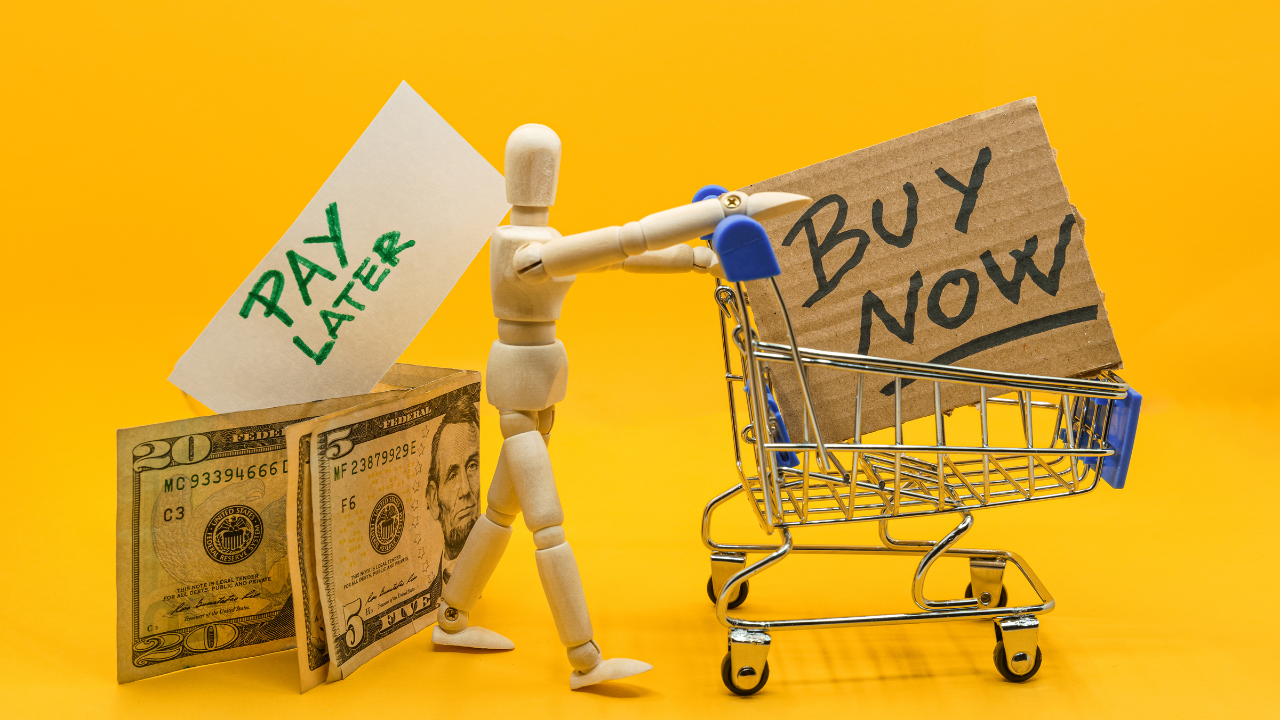
Buy Now, Pay Later has become one of the easiest ways to spend money without really feeling like you're spending it.
Instead of seeing a $400 purchase, you're shown:
4 easy payments of $100.
Same purchase. Same $400.
But psychologically, it feels completely different.
And that's exactly why Buy Now, Pay Later has exploded.
In a 2026 LendingTree survey, 47% of Buy Now, Pay Later users said they had made a late payment within the past year. Another 15% said they had been late at some point in the past.
But being late isn't the same as actually defaulting.
The Consumer Financial Protection Bureau found that in 2023, about 1.83% of BNPL loans were ultimately charged off as uncollectible.
So while most people aren't completely defaulting on these loans, a huge number are struggling to keep up with the payment schedules.
And that's where the real problem begins.
One Payment Doesn't Feel Like Debt
A $40 payment here doesn't seem like a big deal.
Neither does $55 next week.
Or another $28 the week after that.
But suddenly your calendar looks like this:
$42 Klarna on Tuesday
$68 Affirm on Thursday
$27 Afterpay on Friday
$55 PayPal next Wednesday
That's $192 of your future paycheck already spoken for.
And those payments might represent hundreds of dollars worth of purchases that never felt that expensive when you clicked the checkout button.
The CFPB has found that 63% of Buy Now, Pay Later borrowers had multiple BNPL loans at the same time.
A 2026 LendingTree survey found the same percentage had held multiple BNPL loans simultaneously, while 25% had three or more running at once.
That is where “four easy payments” can become anything but easy.
But Isn't Buy Now, Pay Later Free?
Sometimes, yes.
Many traditional Pay-in-4 programs charge no interest if you make every payment on time.
So technically, a $200 purchase could still cost exactly $200.
But interest-free doesn't necessarily mean cost-free.
If you miss a payment, some providers charge late fees.
CFPB data showed the average assessed late fee was about $10 in 2023.
You can also run into overdraft or insufficient-funds fees if an automatic payment hits your bank account when the money isn't there.
And if you stop paying altogether, the debt can eventually be sent to collections.
But even those fees aren't necessarily the biggest cost.
The Bigger Cost Might Be Psychological
In LendingTree's 2026 survey, 68% of BNPL users said Buy Now, Pay Later causes them to overspend.
More than half said they had regretted a BNPL purchase.
Why?
Because Buy Now, Pay Later changes the question in your head.
Instead of asking:
“Is this worth $400?”
You start asking:
“Can I afford $100 today?”
Those are completely different questions.
The total price hasn't changed.
Only the way it's presented has.
Buy Now. Stress Later.
Normally, spending creates immediate friction.
You buy something.
Money leaves your account.
You feel the cost.
Buy Now, Pay Later separates those two experiences.
You get the excitement of the purchase today.
The bill shows up later.
Past You got the package.
Future You got the payment.
That separation can make spending feel easier in the moment, but harder later when several payments start competing for the same paycheck.
Small Payments Can Hide a Big Obligation
Imagine having these four purchases going at once:
$140 clothing purchase
$220 household purchase
$180 electronics purchase
$160 grocery and household order
Each one has been broken into smaller payments.
No individual payment feels huge.
But altogether, you've committed $700 of future income.
And that's the part that can be easy to miss.
At checkout, nobody flashes a giant warning saying:
YOU CURRENTLY OWE $700 ACROSS MULTIPLE PAYMENT PLANS.
You're simply shown the next small payment.
When Buy Now, Pay Later Becomes a Lifeline
This part is especially concerning.
In the 2026 LendingTree survey,
54% of BNPL users said they need Buy Now, Pay Later to make ends meet.
And 29% said they had used it to purchase groceries.
At that point, we're no longer talking about financing a couch or a new pair of shoes.
We're talking about people using future income to pay for today's basic necessities.
Milk.
Bread.
Gas.
Household supplies.
Groceries.
And if you're still paying for last week's groceries while buying this week's groceries, that's a sign that something deeper in the household budget needs attention.
That's not something to be ashamed of.
It's a financial warning light.
The Question to Ask Before Using Buy Now, Pay Later
Before you click that Pay-in-4 button, ignore the payment amount.
Look at the full price.
Then ask yourself:
Would I buy this today if I had to pay the entire amount right now?
If the answer is no, splitting it into four payments doesn't actually make it more affordable.
It just makes it feel more affordable.
Buy Now, Pay Later isn't automatically bad.
If you already have the money, understand the terms and deliberately choose to split the payment, you may pay absolutely nothing extra.
But if you're using it because the full price doesn't fit into your budget, that's worth paying attention to.
Because the most dangerous question isn't:
“Can I afford the first payment?”
It's:
“Can my future paychecks afford everything I'm committing them to today?”
Ready to Finally Make a Budget That Actually Works?
Join the FREE Budgeting Workshop and learn how to:
✅ Build a simple, stress-free budget that fits your real life
✅ Ditch debt and stop living paycheck to paycheck
✅ Plan for future expenses—without relying on credit
✅ Curb wasteful spending and make your money go further
✅ Save for big goals and enjoy your money guilt-free
No complicated financial lingo. No shame. Just real help that works.
➡️ Perfect if you've tried budgeting before and nothing stuck.
🎁 BONUS: Get instant access to free tools to help you take action fast!

Responses